Last updated: 19 June 2026
I was explaining how to read horse racing form to someone recently and watched the same thing happen that happens to almost everyone. They froze. Not because they were not capable, but because the sheer size of the task stopped them dead. There is so much you could look at that the only honest question is the one they asked me straight away: where on earth do I begin?
And it does not stop there. The moment you start, the questions multiply. What does this horse actually prefer? What sort of rivals has it beaten before, and how do they compare to today’s lot? Each answer opens three more doors. I struggled for a long time to explain a way through it, and then I landed on something I have used ever since. I call it the circular form reading method.
The circular form reading method organises everything you could look at into circles of importance. You start in the centre with the handful of factors that decide most races: how well a horse is suited by the ground, the distance, and the race type, plus how competitive it really is. You score every runner on just those, compare them factor by factor, and only once you can do that consistently do you move outward to the finer detail. It works because it tells a struggling form reader where to begin and what to ignore.
Why form reading feels impossible when you start
The problem is not a shortage of information. It is the opposite. A single race card hands you form figures, going, distance, class, the draw, trainer and jockey, days since the last run, and a dozen other things besides, and nobody tells you which ones matter most. So people try to weigh all of it at once, get buried, and conclude they are no good at this. They are not. They have just been handed the whole library and told to read it cover to cover before they place a bet. The fix is to accept that not everything counts equally and to build a clear order of priority, which is all the circular method really is.
How to read horse racing form: think in circles of importance
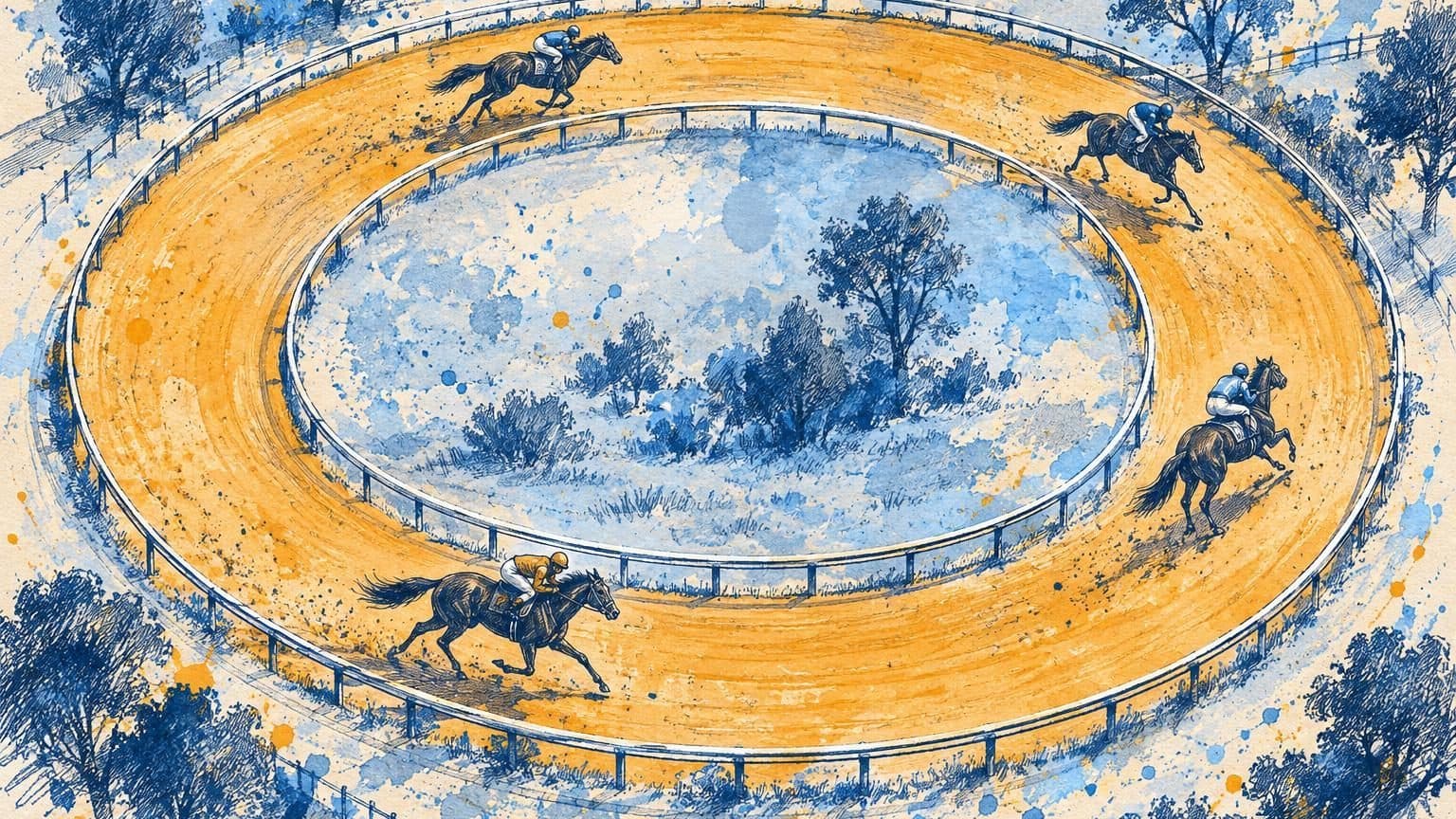
Picture a set of circles, one inside the other, like a dartboard. The small centre circle holds the most important factors. These are the things you must look at to analyse a race at all, and they make up the bulk of the work. Honestly, they make up the bulk of the answer too.
The next couple of rings out hold factors that still matter but sit slightly removed from the centre. They sharpen your read rather than form it. The outermost ring is where the huge mass of remaining detail lives, the information that might help, might mislead, and is genuinely hard to judge either way. There is a lot of it, which is exactly why it is so dangerous to a beginner. When you start, you work in the centre circle and nowhere else. The goal is to learn to read a race well using the centre factors alone, and it is absolutely possible, because those factors carry most of the signal.
What belongs in the centre circle
The centre circle is built from suitability. Is this horse suited by the ground, by the distance, and by the type of race it is running in today? Those three preferences do more to shape a result than almost anything else, because a horse running on conditions that genuinely suit it is a horse running close to its best. A talented animal in the wrong conditions is a horse you can confidently mark down. If you want to go deeper on just one of these, how a horse handles the surface is a good place to start, and being suited by the ground is often the difference between a run full of promise and a flat one.
There is a subtlety here worth holding on to. When Race Advisor looked at more than 900,000 UK runners over the last five years, the going on its own barely moved the value needle. Win rates drift a little from one surface to the next, but the actual-versus-expected figure sat right on 1.00 for every going code, from good through to heavy. The market already knows the ground. What it cannot do for you is decide which of today’s runners is genuinely suited by it, and that judgement is exactly why ground sits in the centre circle and not in the outer rings.
The fourth centre factor is the one people expect to be “class”, and I want you to replace it. Ask instead how competitive this horse is. That sounds like a small change of wording, but it matters, and it deserves its own moment.
Why “how competitive is it?” beats “what class is it?”
Class is an ephemeral word. Ask ten backers what it means and you will get ten slightly different answers, which makes it almost impossible to measure consistently. “How competitive is this horse?” is a far more useful question, because it is specific. You are asking whether the horse has shown it can compete at the level it faces today, against the kind of rivals it is up against. That is something you can actually look for in the form, rather than a vague feeling about how good a horse is. If you want the longer version of why class is a slippery word and competitiveness is the better lens, I have written about it separately, but for the centre circle the rule is simple: judge competitiveness, not class.
The numbers make the case better than I can. Across nearly 400,000 UK handicap runners over the last five years, the top horse on official rating won 14.2% of its races, while the group rated fifth or worse won just 8.2%. So the handicapper’s figure does sort the field by likelihood, and that is useful. But look at the value instead of the win rate and the ladder flattens out completely: the actual-versus-expected return sat between 0.98 and 1.01 at every single rung. Being top rated wins you more races and almost never wins you money on its own. That is the whole point of asking the better question. The rating tells you who is competitive. It does not tell you who is a bet. Reading competitiveness yourself, across the field, is where the edge actually hides.
Work one factor at a time, and write everything down
How you measure each centre factor does not actually matter much, and that surprises people. You can use a rating, you can read the form over the relevant conditions, you can lean on trainer comments. Each of those is valid. It comes down to preference and interpretation, so use whatever technique suits you, as long as you apply it the same way to every horse. Consistency is what makes your read worth anything, not which method you picked.
Whatever you choose, take notes, and take a lot of them. Everything you think about a horse goes on paper. You cannot hold a full race in your head, and pretending you can is where most form reading quietly falls apart. Go through the centre factors for one runner, write down what you find, then move to the next. Start on races with small fields while you are learning, because they take far less time and let you finish a full race without losing the thread.
Compare the field factor by factor
Once you have notes on every runner, the analysis almost does itself. Go factor by factor and ask one question each time: which runner is strongest in this factor? Who is best suited by the ground? Who is best suited by the trip? Who is best suited by the race type? Who is the most competitive at this level? Answer that for each centre factor and the shape of the race is laid out in front of you in black and white.
This is also where Race Advisor’s own ratings earn their place, and the data shows why the comparison matters more than any one figure. Going back across more than 1.5 million UK runners, the top horse on the PR rating won about a third of its races and the top horse on the VDW rating around a quarter, with both falling away sharply down the order. A powerful sort. Yet the actual-versus-expected return clung to somewhere between 0.99 and 1.01 the whole way down. The ranking concentrates the winners beautifully, and the market still prices them. Which is the centre-circle lesson in one line: you are not hunting for the single number that wins, you are comparing the field honestly on the factors that decide most races, and letting the close ones go.
This factor-by-factor comparison is also why you do not need to drown in extra information to make a decision. A disciplined read of a few factors across the whole field beats a scattered read of many factors on your favourite horse. It is the same lesson behind how many factors to weigh: more is not automatically better, and a clear comparison on the things that matter most will take you a long way. If you want to see the centre circle applied at speed, the analyse a race quickly approach is the same idea with the stopwatch running.
Then decide whether the race is even worth playing
With the comparison in front of you, the next decision is one most backers never make. Sometimes you will look down your notes and every runner is fairly well matched, with no horse clearly on top across the centre factors. That is not a failure of your analysis. That is your analysis telling you something useful: this is a hard, open race, and you might be better off leaving it alone.
- If the field is closely matched on the centre factors, treat that as a reason to pass. Open races punish even good reads, and there will be a clearer one along soon.
- If one or two horses stand out as significantly stronger across most of the centre factors, you have your answer to the only question that matters: who could win this race?
That is the quiet power of doing the work properly. You are not just picking a horse, you are deciding whether the race is worth a bet at all, and the honest “no” is worth as much over time as the confident “yes”.
Don’t move to the outer circles too soon
Here is the discipline that holds the whole method together. Do not move out to the second, third, or fourth rings until you can read a race well with the centre alone. The outer tiers are there to improve a read that already works, by adding finer detail on top. Pull them in too early, before the centre is second nature, and they do not help you. They overload you, and they actively slow your progress, because you cannot yet tell the signal from the noise.
So be patient with yourself. Get genuinely comfortable judging suitability and competitiveness across a field, race after race, until it feels routine. The day that happens, the outer circles stop being a distraction and become an edge that you add one factor at a time. There is no prize for skipping the foundation, and this patience sits at the heart of reading the form properly.
Let the tools score the centre circle for you
Doing this by hand, at least for a while, is worth it. It teaches you what actually decides a race and how rarely a horse stands out once you compare the whole field honestly. But you do not have to score every factor with a pen forever. The Race Predictor and the custom race cards already score every runner across dozens of factors at once, ground, distance and race-type suitability among them, and hand you a read on how each horse stacks up against the rest. It is the automated version of the centre-circle work you have just walked through.
Try the method by hand on a small-field race or two this week, then, when you would rather have the factor scoring done for you while you concentrate on the comparison, open today’s racecards and let the Race Predictor lay out the centre circle for every race on the card.