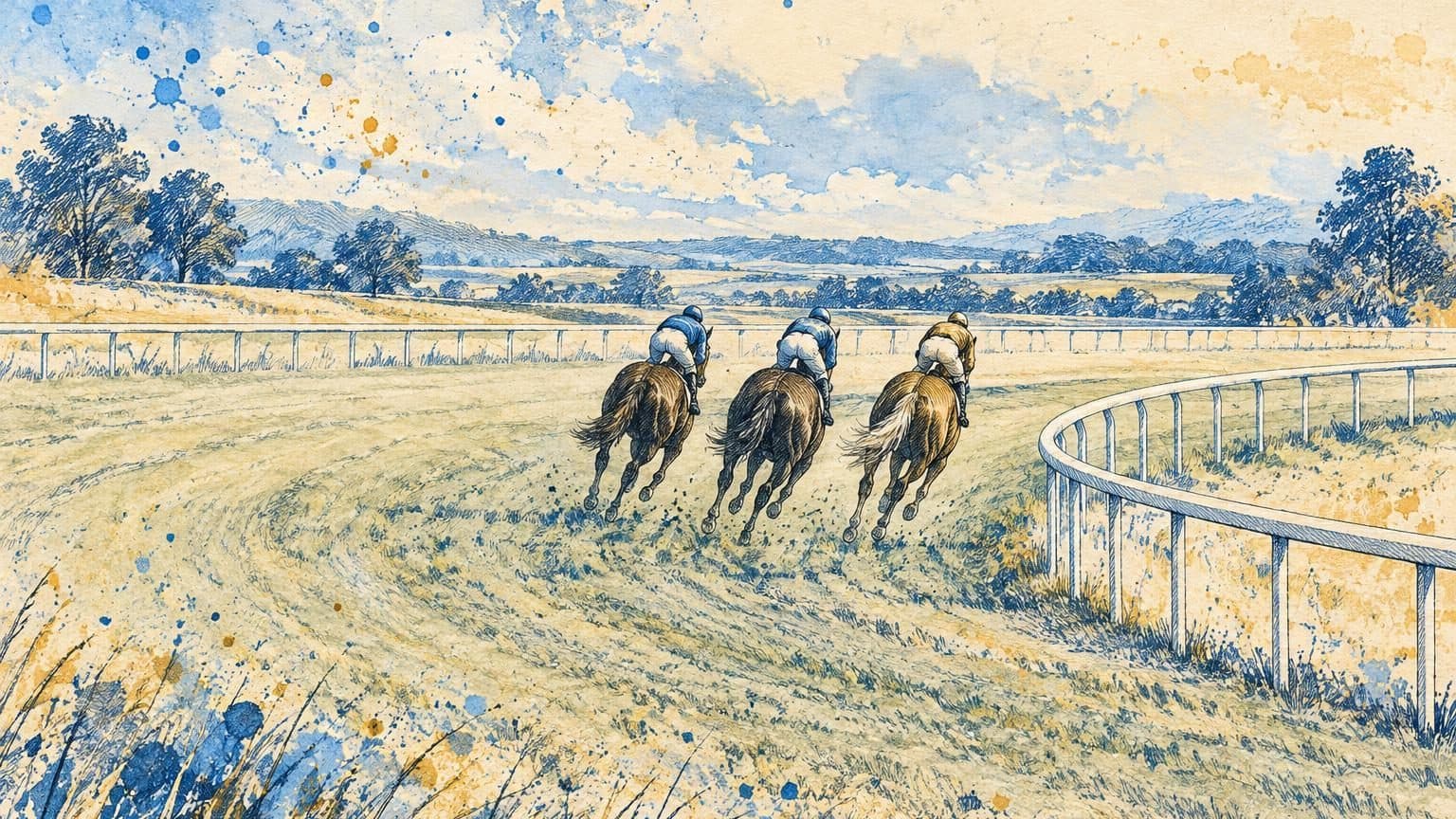
Three runners. The favourite is 8/11, the second favourite is 11/10, and the third horse is a lonely 5/1. You look at that 5/1 and a little voice starts up. It is only a three-horse race. Anything can happen when they stroll round and sprint the last two furlongs. Surely it is worth taking a chance on the one nobody else wants.
Then a second voice answers. The outsider is 5/1 in a three-horse race for a reason. It is the weakest horse in the field, and the two at the front would beat it nine times out of ten. Both voices have a point, depending on the race. The skill is knowing which race you are looking at, because backing the longshot in a small field can offer value in a narrow set of conditions and fair odds, at best, almost everywhere else.
Should you back outsiders in small fields? Only in the narrow case that has paid: short, three-runner races likely to be run at a slow pace, where the favourite has been overbacked and has questions to answer. In four and five-runner fields the longshot is usually just outclassed, so the selective approach is the one that holds up over a season.
Why does a small field change the form?
A big-field handicap is usually run honestly. There is enough pace on to make it a true test, the best horse can use its superiority, and the form works out roughly as the figures say it should. Field size is one of those race conditions that quietly changes the meaning of everything else on the card, the same way going or class does, and a three-runner race is about as far from an honest test as racing gets.
With only three in, nobody wants to make the running. The leaders take it steady, and then everything quickens for home off a sprint up the straight. A superior horse cannot wear down an inferior one over a truly run trip, because the trip was never truly run. It comes down to a short dash where a classier horse can be outsprinted by a lesser one that happens to quicken well. That does not make the outsider likely. It makes it more likely than its price suggests, which is a different and far more useful thing. The question is never “can this horse win?” It is “is this horse more likely to win than the people setting the price think?” Small fields are one of the few places those two answers drift apart.
Why is the three-horse race the real opportunity?
Here is the part most people miss. They hear “back the outsider in a small field” and apply it to anything with single-figure runners. The clearest edge lives in the three-runner race, and it fades as you add horses.
Three runners is the purest version of the slow-pace situation. There are only two horses in front of the outsider, the tempo is likely to be steady, and the race can turn on one tactical mistake by the favourite. These races also attract confident money. Casual bettors back the short favourite because it “can’t lose in a three-horse race”, which may shorten its price past its true chance and, by simple arithmetic, push the outsider out past its true chance. That is a possible mechanism rather than a proven one, and it fits the figures below: the outsider did best when the favourite looked more beatable. When the crowd overpays for the obvious horse, the unfashionable one can become the value almost by accident. What does the work is not the longshot being good. It is a short-priced favourite the market has overvalued, in a race shape that gives a lesser horse a real chance.
In an earlier Race Advisor analysis of the longest-priced runner in every UK three-runner race with a valid Betfair SP since 2013, the picture is encouraging, with one important detail. This is a historical signal from our own data rather than a published betting record, so test it against your own results. Betfair SP is Betfair Starting Price, the exchange’s closing price. A/E means actual winners divided by the winners the odds implied, so 1.00 means a group wins exactly as often as its prices said it should. Our guide to A/E ratios explains it in full. Across more than 2,100 of these races the outsider won 14.0% of the time at an A/E of 1.10, a shade better than its price implied, and it was a touch stronger on the Flat and all-weather than over jumps, with an A/E of 1.11. These figures describe that period and will not repeat exactly.
The value did not come from a dominant odds-on favourite. When the favourite went off odds-on, the outsider won 9.4% of races at an A/E of 1.05. When the favourite was more beatable, sent off at 2.0 or bigger, the outsider won 23.0% of the time at an A/E of 1.14. The best of it sits in the open three-runner race with a vulnerable favourite. Holding out for a flashy price on the outsider added nothing: filtering to runners at decimal odds of 4.0 and up (3/1 and bigger) barely moved the figure, from 1.10 to 1.11.
How are four and five-runner fields different?
The instinct is to treat four and five-runner races as the same bet with slightly smaller odds. They are a different kind of race. In the same earlier analysis the longest-priced runner still showed a small edge on paper, an A/E of 1.06 in four-runner fields and 1.09 in five across thousands of races since 2013, but the strike rate is the key. It falls from 14.0% with three runners to 7.7% with four and 5.2% with five. By the time you reach seven runners the edge has gone entirely, sitting at a fair A/E of 1.00. A paper edge that lands about once in twenty tries takes a very long run of bets to tell apart from chance, and commission trims it further, so those four and five-runner figures are best treated as weaker leads. Add a fourth and fifth runner and two things change. The race is more likely to be run at a sensible gallop, because the chance of at least one horse wanting to press on rises with every extra runner. And the outsider now has to beat three or four rivals instead of two, so the tactical quirk that can win a three-runner race is no longer enough. The slow-pace edge fades, the number of horses to pass climbs, and the longshot drifts back towards being what its price says it is.
This is contextual handicapping in miniature. “Small field” is not one condition. A three-runner stroll and a five-runner gallop are two different races that happen to share a thin look on the card. Treat them as one and the small gains from the three-runner races are given back in the four and five-runner ones.
How do you spot a small-field outsider worth backing?
If the edge only exists in a narrow case, your job is to find that case and set the rest aside. With three runners that takes about ninety seconds, because there is barely any form to read. Start with the favourite, not the outsider. You are looking for an overvalued favourite: a short price that is short for reputation rather than for a watertight case today. Has it proved itself at this trip, on this ground, off this kind of break? Is it odds-on mainly because it is the name everyone knows? A favourite with real questions is the green light. A well-in favourite at a fair price is the moment to move on to the next race.
Then check that the outsider’s profile fits today’s race rather than just hoping for a slow pace to rescue it. A longshot whose best work came over six and seven furlongs is a poor fit when the race is over a mile, however slowly they go. A longshot that handles soft ground, on a soft day, against rivals who may not, is a different proposition. And plan for the strike rate. It is low, and you will watch the favourite win again and again, because most of the time it is the better horse and the race is run honestly enough to show it. A long string of losers is a normal part of this approach, as our guide to losing runs shows, which is why the selective, patient version is the one that lasts.
Does the price have to pay?
Everything above is about whether the horse has a chance. The bet is a separate question, and it decides whether you make money. A longshot with a live chance is still a poor bet if the price is too short. Probability and price are different conversations. The test for whether this angle does anything is the A/E ratio, which compares how often something actually wins with how often the market, priced off Betfair SP, expected it to. An A/E comfortably above 1.00, such as 1.05 or more across a few thousand races, says the outsiders are winning more often than their prices implied, and the bigger the sample the more you can trust it. An A/E around 1.00 says the market has the small-field outsider priced correctly, however appealing the 5/1 looks.
The market favourite shows the same thing from the other side. Across tens of thousands of three to seven-runner races since 2013 it came home at an A/E of 0.99 to 1.00, whether it won 57% of three-runner races or 37% of seven-runner ones. It is priced almost perfectly, so it offers neither an edge to back nor an edge to oppose blindly. The one crack worth working is the selective outsider in the open three-runner race, and only when the price is bigger than its real chance.
So the rule is simple, even if the discipline takes practice. The outsider in a small field is only a bet when two things are true at once: the three-runner slow-pace setup is there with a beatable favourite, and the price is bigger than the horse’s real chance. That second condition is value, the thing that matters over a long run of bets. Get both and you have a genuine, if occasional, edge. Get only the first and you have a good story and a fair price.
A simple check for the second condition is to turn the price into a chance. 5/1 implies about a 1 in 6 chance, or 16.7%, so ask whether you would honestly make this horse a bigger chance than that, given the pace and the favourite’s questions. If you cannot say yes with a reason, leave it. This guide points to a setup worth investigating, rather than a complete betting rule.
What is the takeaway?
Do not back an outsider for being the longshot, and do not dismiss it for being the longshot. Read the favourite, read the likely pace, read the conditions, then make the price prove the bet. No approach can promise a profit, and this one keeps you selective and gives your edge the best chance to show up.
To put it into practice, open today’s race cards, pick out the small fields with a beatable favourite and a steady race in prospect, and keep a record of how the longshots run. Over a season, that record tells you whether you are finding value or just following a hunch.