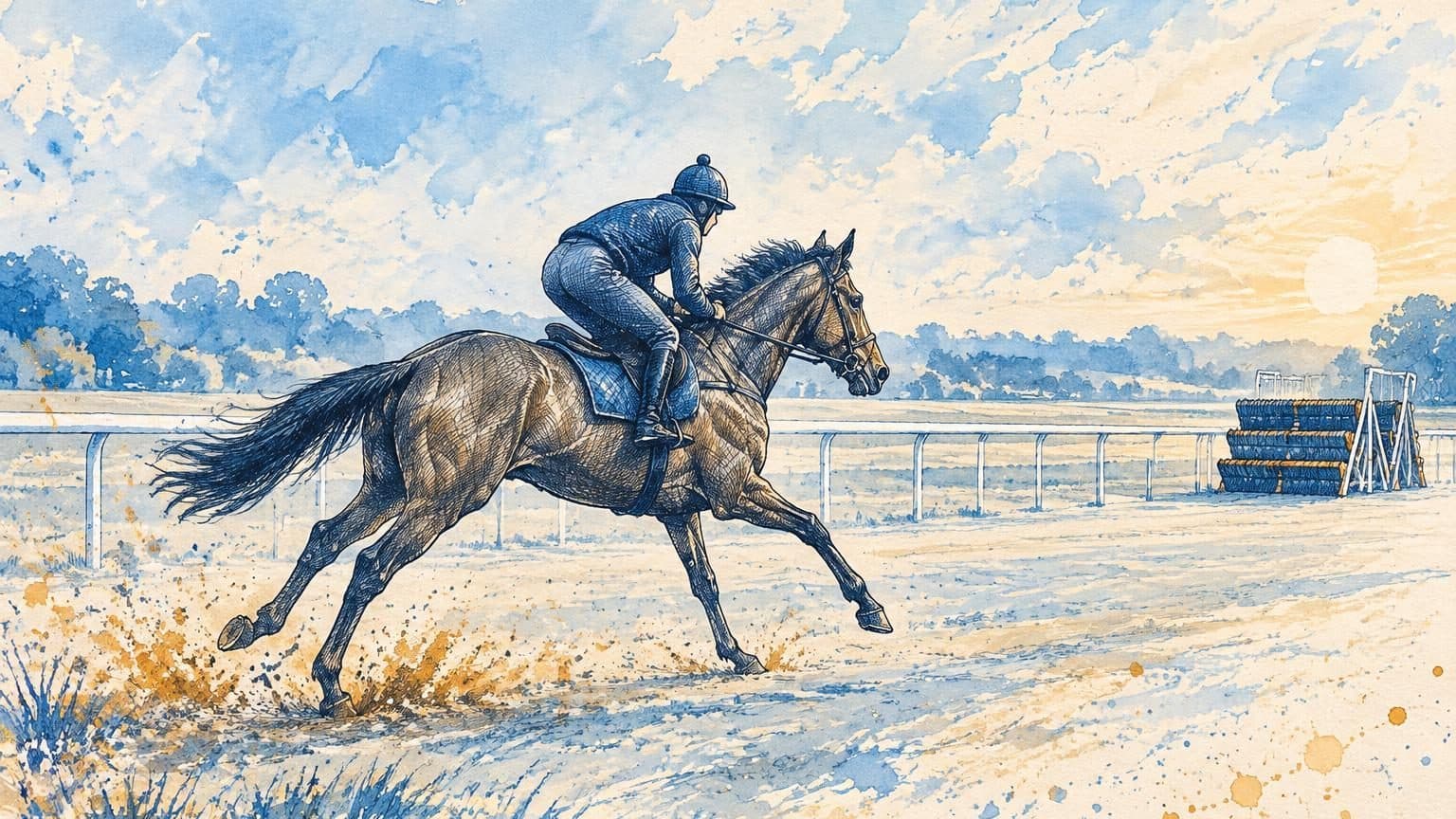
It’s the last race of a cold afternoon at a jumps meeting. Half the crowd is already drifting towards the car park, and out on the track a field of young horses is walking round behind an elastic tape stretched across the course. Not one of them has ever jumped a fence in public. There isn’t a hurdle in sight, and there are no starting stalls either. That’s a bumper… and it’s one of the oddest and most interesting races on the card.
What is a bumper horse race? A bumper is the everyday name for a National Hunt flat race. It’s run on the flat, with no hurdles or fences, but under the rules of jump racing, for young horses that haven’t raced over obstacles yet. It usually closes the card, it starts from a tape rather than stalls, and it’s where many future hurdlers and chasers get their first taste of a racecourse.
The short version
- A bumper is a flat race for horses bred and trained to jump, with nothing to jump.
- Runners must be new to the sport, or have run only in similar races, so most are debutants or have very few runs.
- Most are run over around two miles, and they usually come last on the card.
- They are about potential rather than form, which is why they are harder to read and why they reward a plan.
What is a bumper in horse racing?
Racing in Britain and Ireland comes in two big families. Flat racing is run without obstacles. National Hunt racing, also called jump racing, is run over hurdles and fences. A bumper sits in an odd spot between the two. Its official name is a National Hunt flat race: it’s run on an ordinary racecourse with no obstacles, exactly like a flat race, but it’s governed by National Hunt rules and it’s meant for horses whose future lies over jumps.
That’s what confuses newcomers. On the racecard a bumper is listed among the jump races, yet the horses never leave the ground. The easiest way to think of it is as a school gate for jumpers. The horses are young, most are bred for stamina rather than pure speed, and the race gives them a first taste of the crowd, the pace and the rough and tumble of a real field before anyone asks them to jump anything.
Why are bumpers called bumpers?
Nobody has settled this for certain, and the Jockey Club says there are plenty of theories. The most common story is that these races were once restricted to amateur riders, who were less polished than the professionals and tended to bounce around in the saddle. A second version says the name comes from inexperienced horses and inexperienced riders literally bumping into each other. Neither can be proved, but both tell you what a bumper was meant to be: a gentle introduction, not a test for seasoned performers. Today the riders are a mix. Conditional riders (young professionals still learning the job, who get a weight allowance) and amateurs still take part, and flat jockeys sometimes take out a jump licence, which is the permit needed to ride under jump rules, just so they can ride in them.
How do bumper races work?
The rules are simpler than the name suggests. Three things matter: who can run, how far they go, and what they carry.
Who can run in a bumper?
As a general rule, a bumper is for young horses that haven’t raced in other forms of the sport. In Britain the runners are normally seven or younger, and they haven’t raced on the flat or over hurdles or fences. The only racing they have usually done is in bumpers themselves, or in the Irish and French equivalents. Many races narrow it further, and a typical race might be restricted to four and five-year-olds. There are exceptions: the BHA has staged special “Jumpers’ Bumpers” on the all-weather that were open to horses which had already run over hurdles or fences. That’s why the conditions printed for the individual race are what count, and it’s worth getting into the habit of reading them.
How far do they go, and how do they start?
Most bumpers are run over around two miles, with some a little further, so you will see distances such as two miles and a furlong and a few yards. Here’s the detail that surprises people: despite being flat races, bumpers don’t use starting stalls. As in other jump races, they start from behind an elasticated tape across the track.
What weights do they carry?
Weights are set in the race conditions. Younger horses carry less than older ones, and fillies and mares usually receive an allowance. In the Champion Bumper at the Cheltenham Festival, for example, a four-year-old carries 10st 11lb, five and six-year-olds carry 11st 7lb, and fillies and mares get 7lb off. Other bumpers use their own figures, so check the card for the race in front of you.
What is the point of a bumper?
A bumper has a job to do for almost everyone involved. For the trainer it’s a low-pressure way to see how a young horse copes with a real race: whether it settles, how it deals with company, and whether it has the stamina and the temperament to be worth sending over hurdles. For the owner and the breeder it’s a first public sign of whether the horse can run at all, and a good bumper run can raise a young horse’s profile quickly. For the racing fan it’s a chance to see tomorrow’s jumpers before they become famous.
It’s also the reason bumper form needs reading carefully later. A horse that finishes mid-field on debut in a bumper may simply have been green, which means the result on its own tells you less than it would in most other races.
How do bumpers fit in with hurdles and chases?
A bumper is usually the first rung of a ladder. The typical path for a young jumper is a bumper, then novice hurdles, then perhaps novice chases, though plenty of horses skip the bumper and go straight to hurdling, and plenty never move on to fences. Here’s how the three types compare.
| Race type | Obstacles | Who usually runs | What it shows |
|---|---|---|---|
| Bumper (National Hunt flat race) | None | Young horses new to racing, or with very few runs | Potential, stamina, temperament |
| Hurdle race | Low hurdles | Horses learning to jump, then more experienced hurdlers | Jumping ability and speed over obstacles |
| Steeplechase | Larger fences, some with an open ditch | Experienced jumpers, often older | Stamina, boldness and accurate jumping |
The early weeks of the jump season are full of horses returning from a summer break and young ones making their debuts, which is exactly what makes them tricky for backers. If you want to see how that changeover from flat to jumps affects your betting, our guide to betting the flat to National Hunt transition covers it.
The Champion Bumper and other famous bumpers
The most famous bumper by a distance is the Champion Bumper at the Cheltenham Festival. It’s a Grade 1 run on the Old Course over about two miles and half a furlong, and it’s open to horses aged four to six. It was first run in 1992 as the Festival Bumper and has carried the Weatherbys name since 1997. It’s also the only race at the Festival where the runners don’t have to leave the ground, which makes it a neat finish to the second day.
Its roll of honour is a good advertisement for what a bumper can show you. Dato Star, in 1995, was the first British-trained winner. Florida Pearl won in 1997 and Cue Card in 2010, and both went on to become top-class jumpers. Willie Mullins is the dominant name in the race’s history, with winners in double figures. Elsewhere, Ireland has its own big bumpers, including the Grade 2 at the Dublin Racing Festival and a championship race at Punchestown in the spring. Most Irish jumps cards include a bumper, while in Britain they come up less often.
What should you expect if you go racing?
If you’re at the track, don’t be surprised if a bumper has a different feel. It’s usually the last race, so the crowd is thinner and the light may be fading. The horses often look big, raw and a little unfinished, and some are visibly green in the paddock. There’s no jumping to watch, so the interest is in the pace, who travels smoothly, and who finishes strongest. Reading a few clues before the off helps a lot, and our guide to how to read a horse racing racecard is a good place to start if the abbreviations still look like code.
Should you bet on bumpers?
Bumpers have a reputation as some of the hardest races on the card to predict, and the reason is simple: many of the runners have little or no form to read. That doesn’t mean you can’t approach them sensibly. It means swapping one set of clues for another, and being honest that these clues are weaker than form. With no form to read, you read the people and the pedigree.
You can check most of it yourself. Look at how the trainer’s earlier bumper runners fared, because some yards are known for bringing young jumpers to the races ready to run and others use bumpers purely as a learning exercise. Look at the breeding, since stamina-bred horses tend to suit the trip and the steadier pace of many bumpers. Watch the price: a debutant whose odds have shortened since the morning is being backed by someone, which is a clue worth noting, while one that has drifted out is telling you something too. And if a horse has run before, look at how it finished rather than just where, because a young horse staying on strongly may be better than its result suggests.
Treat each of those as a reason to look closer, never as a reason to bet. A strong trainer record, good breeding or a firm market only matters if the odds on offer are bigger than the horse’s realistic chance, and nothing in a bumper turns an uncertain race into a certain one. With so little information, you might sensibly decide a bumper isn’t the place for you, and that’s a perfectly good result. Our plain guide to value betting explains what value really means, which is the test for any bet, and if you do get involved, keeping stakes modest suits races where the evidence is thinnest. Nothing guarantees a return, and the point of reading the clues is to make better decisions, not to promise yourself a winner.
Related National Hunt race types
Bumpers are one of several race types that sound similar. Here’s a quick guide to the others you’ll see on a jumps card.
- Maiden: a race for horses that have never won, over hurdles or on the flat. It does not mean fillies only.
- Novice: a hurdle or chase restricted to horses with limited experience over those obstacles, so many bumper graduates appear here.
- Juvenile hurdle: a race for the youngest horses allowed to jump hurdles, usually three-year-olds.
- Beginners’ chase: a chase restricted to horses that have never won a steeplechase.
- Hunter chase: a steeplechase for amateur riders on horses that have been hunted or run in point-to-points.
- Graded races: the top level in jump racing, with Grade 1 as the highest, where the Champion Bumper sits.
If you want to understand how the race conditions on a card shape the betting, our guide to race conditions goes into more detail.
Frequently asked questions about bumpers
What exactly is a bumper race?
A bumper is a National Hunt flat race: a race on the flat, with no obstacles, run under jump racing rules for young horses that haven’t raced over hurdles or fences. It’s usually the last race on a jumps card and starts from a tape instead of stalls.
How are bumpers different from other races?
They have no obstacles, unlike hurdles and chases, and the runners are young and inexperienced, unlike most flat races where horses are bred for speed. The restriction on previous racing means most fields contain unknowns, so there is far less form to go on.
Why do bumpers matter?
They are the first rung for many future jumpers. They show trainers whether a young horse has the temperament and stamina to continue, and they give fans an early look at horses that may go on to the top races, as Florida Pearl and Cue Card did.
What this guide doesn’t cover
This guide explains what a bumper is, who runs in it and how to read one at a glance. It doesn’t give you a system for backing them, because bumpers are the race type where the evidence is thinnest, and a method built on thin evidence deserves caution. The best way to learn is to watch a few. Next time you’re looking at a jumps card, find the National Hunt flat race at the end of the afternoon on today’s racecards and run your eye down the runners using the clues above.