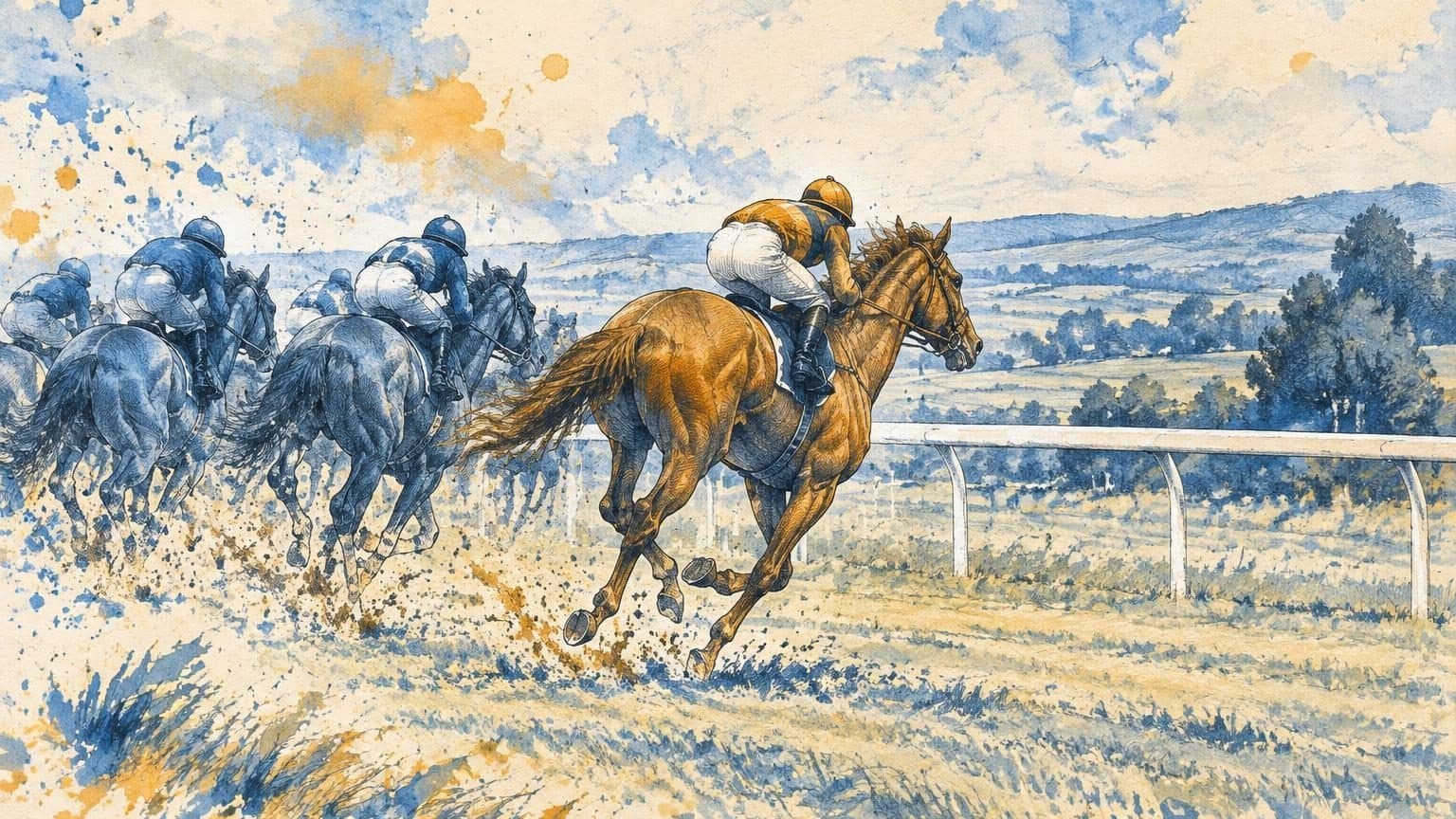
You have followed a horse for a season and it has never done much. Then the card puts it back at the track where it won last year, and suddenly the price looks tempting. “Horses for courses”, you think.
It is one of the oldest instincts in racing, and the wording makes it sound almost mystical, as if a horse and a venue were made for each other. The instinct has a solid core. Horses suit a particular bundle of conditions, so a course win is a clue to the conditions worth checking, and those conditions often turn up at other tracks too.
So does a past win at a course mean the horse is worth backing there again? It tends to win more often, but the price already knows that. This piece covers what the phrase points at, what Race Advisor’s data on UK runners since 2013 shows, and how to use course preference as one input among several.
What does “horses for courses” really point at?
A horse that wins at Nottingham over five furlongs is showing it handles a profile that several other tracks share. It is showing it handles a set-up.
Think of any racecourse as a stack of variables. Left-handed or right-handed. Sharp turns or a galloping track. A stiff finish or a downhill one. A short sprint or a long, draining run. A horse that wins there is telling you about the package. Change one variable, say a flat finish for a stiff uphill one, and the earlier form may not carry over at all. If you want the layout details for individual tracks, our guide to UK racecourse details is a good place to start.
This is contextual handicapping in its simplest form. A finishing position only means something once you put it back inside the conditions that produced it. A “course winner” badge in the form is shorthand for “this horse handled a set-up that exists at this venue”. That is useful, as long as you ask whether today’s set-up is the same one.
What does the data say about course and distance form?
In an earlier analysis of every UK runner from July 2013 to March 2026, covering over 1.5 million runners and 161,000 winners, around 444,000 runners carried some kind of course or distance form. Here is how they did compared with horses that had none.
| Form type | Win rate |
|---|---|
| Course winners | 13.1% |
| Distance winners | 12.0% |
| Course and distance winners | 12.8% |
| No course or distance form | 10.0% |
So your gut feeling is grounded in something real. Horses with this kind of form do win more often.
The next question is whether the price reflects that. A/E (actual wins divided by the wins the odds implied) answers it. At 1.00 a group wins exactly as often as its prices suggested. Every one of those course and distance groups sat at 1.00 or 1.01 in that analysis. In other words the market had already noticed the course form and priced it in.
Backing every course and distance winner therefore gets you the market price, with Betfair commission coming off any winnings. More on the standalone numbers is in our guide to course and distance winners and our explainer on A/E ratios. These figures describe that stretch of racing and will not repeat to the decimal, so treat them as a picture of how the market behaved rather than a promise.
What do the slices of course form show?
Slicing the data by racing code shows the same picture, again from that earlier analysis. Horses with course and distance form returned these A/E figures.
| Code | Runners | A/E |
|---|---|---|
| Flat turf | 199,000 | 0.99 |
| All-weather | 90,000 | 1.01 |
| Hurdles | 82,000 | 1.00 |
| Chases | 68,800 | 0.98 |
Every code lands within a couple of hundredths of 1.00, so the market priced course form accurately across the board.
One slice stands out on win rate alone. Horses with prior course or distance form that returned to the track within 7 days won 16.2% of the time, across nearly 26,000 runners. That is higher than the groups above. It may simply reflect horses that are fit and in form, and a higher win rate does not tell you whether the price was fair. So it is a good place to look closer.
How can you get the most from course preference?
Treat course form as a confirming detail inside a wider picture, not a filter on its own. This is an idea to test on your own results, not a rule. To test it, note for each selection whether it had course or distance form and what price it won or lost at, then compare the two groups after a decent number of bets.
A sensible order of work looks like this.
- Build a shortlist first from the basics: a rating you trust, a sensible pace map, a trainer running well in the last fortnight, and a price that looks fair against your own estimate.
- Then ask whether the runner has course or distance form, and whether today’s conditions (code, trip, going) match the earlier run.
- If they match, the badge adds a little to a case that already stood up. If they differ, give the badge less weight.
Treat the maxim the way a careful form student treats recent form figures. It works best as confirmation rather than as a headline.
What should you take from it?
Across 13 years and more than 1.5 million runners, course and distance winners won more often than horses without that form, and the prices matched how often they won. The win rate gap is real, and the prices already reflected it, so the badge works best alongside your other checks.
If you want to see how course suitability sits next to the rest of a runner’s profile, open today’s race cards and for a runner you know well, note whether its course form is already reflected in the price on offer.